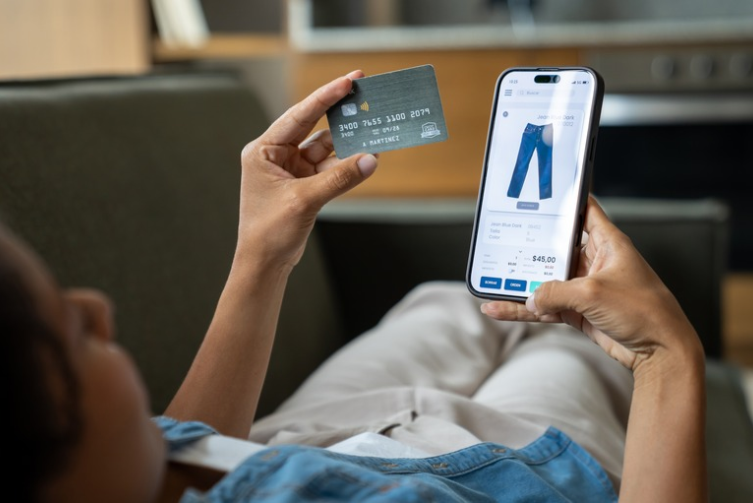
Your cart comes to $286.40. You hesitate. Then, right below the total, another number appears: $71.60 today.
That feels different.
Nothing about the purchase changed. You’re still spending $286.40. But “four payments of $71.60” has a way of making the decision feel smaller.
That’s part of the appeal of Buy Now, Pay Later, or BNPL. Pay-in-four plans typically split a purchase into four installments, often without interest, with payments collected over several weeks or months.
Used thoughtfully, that can be convenient. The trouble starts when the checkout screen is doing more math than you are.
Before you choose Pay in 4, zoom out for a minute.
Would you still buy it at the full price?
Ignore the installment amount and look at the total again. Would you spend $286.40 on this today?
That question cuts through a lot of the psychology built into installment payments. If the full price feels uncomfortable but $71.60 feels easy, the financing may be changing how affordable the purchase seems.
There’s nothing inherently wrong with splitting up a purchase you already planned for. But if Pay in 4 is what turns a “probably not” into a “sure,” give yourself another minute.
You aren’t saving $214.80. You’re committing it to future paychecks.
What else have those future paychecks already promised?
This is where BNPL gets harder to track. One installment plan is easy enough to remember. Several purchases spread across different apps, retailers and due dates are another story.
Before adding another plan, look at what’s already scheduled to come out over the next few weeks.
For Hughes members,
myHUB Money Insights can help here. It automatically categorizes spending and includes a look-ahead calendar for upcoming income and bills. You can also link eligible outside accounts, which is useful if your spending is spread across more than one financial institution.
The goal isn’t to account for every penny before you buy something. It’s simply to know whether that “easy” payment is about to land in an already crowded week.
When does payment two hit?
The first payment gets all the attention because it’s the one standing between you and checkout. The later ones deserve more attention.
Many pay-in-four plans collect payments every two weeks. That means a holiday purchase made in November could still be pulling money from your account well into December.
Pull up the calendar.
Where do those dates fall relative to payday? Rent or mortgage? Utilities? Insurance? Travel? Other holiday shopping?
A $60 payment might fit comfortably this Friday and feel very different two Fridays from now.
This is also where myHUB’s view of upcoming bills can be more useful than looking only at your current balance. Your balance tells you what’s there now. It doesn’t tell you what already has dibs on that money.
What happens if the money isn’t there?
“Interest-free” is easy to hear as “free.” It isn’t quite the same thing.
Many BNPL companies charge late fees when a payment is missed. If automatic payments are tied to a checking account that doesn’t have enough money available, there may also be overdraft or insufficient-funds consequences depending on the transaction and account.
And if a BNPL balance goes unpaid long enough, it can end up with a debt collector.
None of that makes BNPL uniquely dangerous. It does mean you should read the terms with the same attention you’d give any other loan.
Check how payments are collected, what happens if you’re late and whether you can change a due date if your circumstances change.
The checkout button will still be there when you’re done.
Will this show up on your credit?
The answer used to be fairly simple. It isn’t anymore.
Historically, many pay-in-four loans weren’t reported to the major credit bureaus. That landscape is changing. Some BNPL providers now report certain loans, while others do not, and the way that information is used can vary by credit bureau, lender and scoring model.
The useful takeaway is not to assume that BNPL exists in a completely separate universe from the rest of your credit.
If you use these services regularly, keep an eye on your credit report.
Hughes members can do that through
CreditSmart powered by SavvyMoney in Digital Banking. CreditSmart gives you access to your TransUnion credit report and VantageScore 3.0, along with alerts and information about the factors affecting your score. Checking it is a soft inquiry, so it won’t lower your score.
Not every BNPL account will necessarily appear there. CreditSmart is still a good place to keep tabs on the bigger picture and catch changes or unfamiliar information.
And what if you return the purchase?
This one is easy to overlook during holiday shopping. When you buy something with BNPL, the retailer and the company financing the purchase are two different parts of the transaction.
Returning the item doesn’t always mean your payment schedule disappears immediately.
Refund timing and policies vary, so check how returns work before using BNPL for something likely to go back: clothes, shoes, gifts or anything you’re ordering in multiple sizes “just to see.”
Keep your receipt. Watch the account. Make sure the refund actually posts. Until it does, don’t assume the next payment is canceled.
One last question
Before hitting Pay in 4, ask yourself something the checkout screen can’t answer:
Do I want this purchase taking up room in next month’s budget?
Not “Can I afford $71.60 today?”
Next month.
That’s the part of the purchase you’re really deciding on.
If you’ve checked the total, looked at your other obligations and know the installments fit comfortably, BNPL may simply be a convenient way to pay.
If the only reason the purchase works is because most of the bill belongs to Future You, waiting may be the better deal.
Hughes members can use myHUB Money Insights to see spending, budgets and upcoming expenses in one place, and CreditSmart to keep an eye on their broader credit picture.